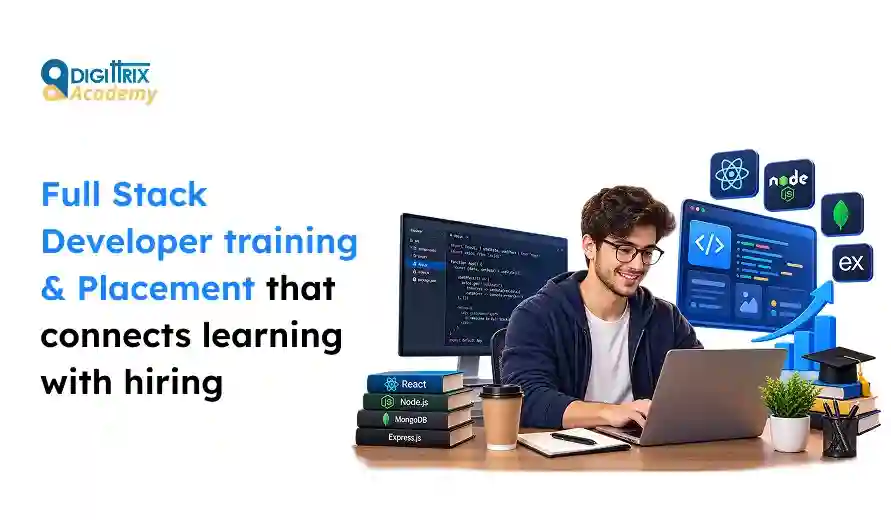
Starting a career in software development requires more than completing programming lessons or collecting certificates. Employers often look for candidates who can build applications, write clean code, work with databases, integrate APIs, and explain the projects they have created. Full Stack Developer Training and Placement helps bridge technical education and practical development work, preparing candidates for job opportunities.
A structured program can help students progress from basic programming concepts to building complete web applications. In addition to technical topics, career preparation may include project guidance, coding practice, resume preparation, mock interviews, and support throughout the job application process.
Looking to become a full stack developer with MongoDB, Express.js, React, and Node.js? Explore Digittrix Academy's MERN Stack Learning Program guide for details on the learning path, practical projects, and full stack development skills.
What Is Full Stack Developer Training and Placement?
Full Stack Developer Training and Placement is a career-focused approach that prepares candidates for both the technical and professional aspects of becoming a software developer.
A full-stack developer works across multiple layers of a web application. This can include front-end interfaces, server-side functionality, databases, APIs, testing, debugging, version control, and deployment.
A complete course may cover technologies such as HTML, CSS, JavaScript, React, Node.js, Express.js, MongoDB, SQL, Git, and GitHub. Students may also choose location-based programs such as a JavaScript Full Stack Course Chandigarh when looking for structured classroom or practical training options.
Why Full Stack Developer Training and Placement Matters for Job Seekers
Modern web applications consist of several interconnected components. Users interact with the front end, while the back end processes requests, manages application logic, and communicates with databases.
Because of this, developers with knowledge of both client-side and server-side development can contribute across different stages of an application.
A full stack developer may work on tasks such as:
- Creating responsive web pages
- Building user interfaces
- Developing REST APIs
- Connecting applications with databases
- Adding authentication systems
- Managing user data
- Fixing bugs
- Testing application features
- Using Git for code management
- Deploying web applications
For freshers, knowledge of these areas can provide a broader technical foundation. However, merely listing technologies on a resume is not enough. Employers often ask candidates to explain how they used specific tools while building projects.
For example, students who complete the React JS Course in Chandigarh training should be able to explain components, state management, routing, API integration, and their roles in a working application.
Practical experience helps candidates answer technical questions by drawing on examples from their own work.
A Structured Path from Fundamentals to Full Stack Development
A good full-stack program usually begins with programming and web development fundamentals before moving towards larger applications.
Students may start with HTML and CSS to understand web page structure and styling. JavaScript then introduces programming logic, functions, objects, asynchronous operations, and interactive web features.
After building a foundation in front-end development, students can use React to build dynamic user interfaces. This stage may cover components, props, state, events, routing, forms, and API connections.
Candidates can then move towards server-side development. A Node.js training program in Chandigarh, for example, may cover server creation, routing, middleware, API development, authentication, and communication between the application and the database.
Database knowledge is another important part of full-stack development. Applications need systems to store and retrieve information such as user accounts, products, orders, and application records. A MongoDB Training Institute Chandigarh course can introduce database design, collections, documents, queries, and database connections for web applications.
By combining front-end, back-end, and database skills, students can build applications with multiple interconnected features.
Practical Projects Help Candidates Show Their Skills
One of the biggest differences between basic technical knowledge and job readiness is the ability to demonstrate completed work.
A candidate may list React, Node.js, or MongoDB on a resume, but an interviewer may ask questions such as:
What application did you build using these technologies?
How did the front end communicate with the back end?
How did you design the database?
How did you manage authentication and user data?
What technical problems did you face during development?
Project work gives candidates real-world examples to discuss.
Full stack development projects can include:
- E-commerce websites
- Job portals
- Task management applications
- Appointment booking systems
- Blog platforms
- Learning management systems
- Admin dashboards
- Inventory management applications
- Social media platforms
The value of a project lies in understanding the work behind it. Candidates should know the application architecture, technologies used, database design, API routes, authentication process, and problems solved during development.
Students taking a Full Stack Web Development Training Chandigarh program should ideally work on projects that integrate front-end, back-end, and database concepts rather than completing only separate exercises.
A strong portfolio of relevant projects can also help recruiters understand a candidate's practical abilities.
Backend Development and Application Logic
The back end is responsible for handling the processes that users do not directly see. It may manage data, user authentication, business logic, APIs, and database communication.
A Backend Development Course in Chandigarh can introduce candidates to server-side programming and help them understand how applications process requests and return responses.
Important backend topics may include:
- Server setup
- API development
- Routing
- Middleware
- Authentication
- Database integration
- Error handling
- Security basics
- Request and response handling
For a full-stack developer, understanding the relationship between the front end and back end is important. When a user submits a form or logs in to an application, the interface sends information to the server. The server processes that information, communicates with the database when required, and sends a response back to the application.
This complete flow becomes easier to understand when students build and test it.
How Full Stack Developer Training and Placement Connects with Hiring
Full Stack Developer Training and Placement is not only about completing technical modules. The hiring process often requires candidates to demonstrate their knowledge through coding assessments, technical discussions, project presentations, and interviews.
This is where career preparation becomes part of the training process.
Resume Preparation
A software developer's resume should clearly present technical skills, projects, internships, education, and relevant experience.
Instead of listing every technology on a long list, candidates should mention skills they can confidently discuss. Project descriptions should explain what the application does and identify the technologies used.
Technical Interview Practice
Technical interviews may include questions on JavaScript, React, Node.js, databases, APIs, programming concepts, debugging, and projects.
Mock interviews can help candidates practise answering questions and identify topics that need additional preparation.
Coding Practice
Many companies use coding rounds or technical assessments. Regular problem-solving practice helps candidates become more comfortable with writing and explaining code.
Project Discussions
For freshers, projects can be an important part of technical interviews. Candidates should be prepared to explain what they built, how the application works, and why they chose particular technologies.
Communication and HR Preparation
Candidates may also need to introduce themselves, discuss their career goals, explain technical projects in simple terms, and answer common HR questions.
These activities help connect classroom training to the actual recruitment process.
What Does Placement Support Usually Include?
Placement support and a guaranteed job are not the same. Candidates should understand this difference before joining a course.
Placement support may include:
- Job opportunity updates
- Resume reviews
- Portfolio guidance
- Mock interviews
- Technical interview preparation
- Coding practice
- Career guidance
- Internship information
- Referrals or interview opportunities where available
Final selection generally depends on the candidate's technical ability, project knowledge, interview performance, communication skills, company requirements, and available openings.
Before joining a program, students can ask:
- What technologies are included in the course?
- Are practical projects part of the training?
- Is technical interview preparation available?
- Will I receive resume and portfolio guidance?
- Are coding assessments included?
- Is internship assistance available?
- How does the placement process work?
- What entry-level roles can I apply for after completing the course?
Clear answers can help students compare programs and choose one that aligns with their career goals.
Full Stack Developer Jobs for Freshers
Freshers can apply for various entry-level positions based on their skills and the employer's requirements.
Common job titles include:
- Junior Full Stack Developer
- Web Developer
- Front-End Developer
- Back-End Developer
- JavaScript Developer
- React Developer
- Node.js Developer
- Software Developer Trainee
- Associate Software Engineer
Not every candidate starts as a Full Stack Developer. Some professionals begin as interns, trainees, front-end developers, or junior software developers before taking on broader responsibilities.
This is why a broad technical foundation can be useful. Candidates who understand how user interfaces, servers, APIs, and databases work together may be able to apply for a wider range of development roles.
Who Can Join Full Stack Developer Training?
Full-stack development programs can be suitable for people from diverse educational backgrounds.
They may be useful for:
- College students
- Recent graduates
- Engineering students
- BCA and MCA students
- Computer science students
- IT students
- Career switchers interested in software development
- Professionals moving into web development
Beginners can start with programming and web development fundamentals before moving on to larger applications. Previous coding experience can be helpful, but regular practice is important for everyone.
Writing code, testing features, fixing errors, and improving projects are all part of the process of preparing for development roles.
How to Choose the Right Full Stack Training Program
When comparing courses, students should look beyond promotional claims and focus on the program's actual structure.
A useful course should provide a clear syllabus that covers the journey from programming basics to complete application development.
Check whether the program includes:
- Programming fundamentals
- Front-end development
- JavaScript
- React
- Back-end development
- Node.js
- Database concepts
- MongoDB or SQL
- API development
- Git and GitHub
- Practical projects
- Debugging and testing
- Technical interview preparation
- Resume and portfolio guidance
- Career or placement support
Students should also consider whether the program offers sufficient opportunities to write code and build applications independently.
The aim should not be to finish a course quickly. Candidates should focus on gaining the knowledge and practical experience needed to apply for relevant software development roles.
Looking to build practical skills with MongoDB, Express.js, React, and Node.js? Explore Digittrix Academy's MERN Web Development Course guide to learn about the projects, skills, and development experience covered throughout the course.
Final Words
Full Stack Developer Training and Placement can offer a practical pathway for students, freshers, and career switchers preparing for software development roles. The most effective approach combines programming knowledge, front-end and back-end development, database work, hands-on projects, coding practice, and interview preparation.
The main goal is not merely to complete a course. Candidates should be able to build applications, understand how technologies work together, explain their projects clearly, and prepare for technical recruitment processes.
With consistent practice, meaningful projects, and proper career preparation, aspiring developers can progress from technical education to entry-level opportunities in web and software development.
About the author
Co-Founder: Harsh Abrol
With Over 14 years of Experience in the IT Field, helping companies optimize their products for more Conversions.
Categories
MERN DevelopmentTable of Contents
- What Is Full Stack Developer Training and Placement?
- Why Full Stack Developer Training and Placement Matters for Job Seekers
- A Structured Path from Fundamentals to Full Stack Development
- Practical Projects Help Candidates Show Their Skills
- Backend Development and Application Logic
- What Does Placement Support Usually Include?
- Full Stack Developer Jobs for Freshers
- Who Can Join Full Stack Developer Training?