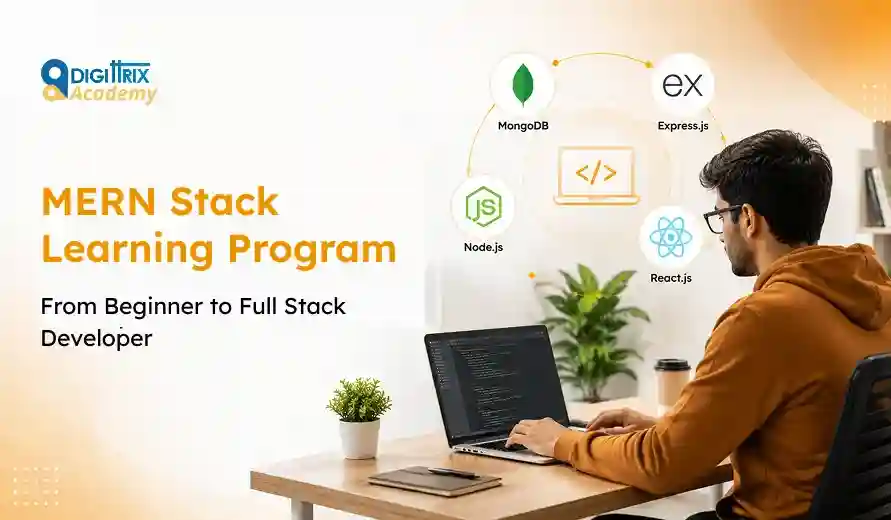
A MERN Stack Learning Program provides beginners with a structured pathway into full-stack web development through coding practice and project work. MERN stands for MongoDB, Express.js, React.js, and Node.js. These technologies can be used together to build websites, business applications, dashboards, online stores, customer portals, and other web-based products.
For a beginner, full-stack development can involve many subjects, including HTML, CSS, JavaScript, frontend development, backend programming, databases, APIs, authentication, Git, testing, and deployment. A structured program divides these subjects into manageable stages. Students start with web basics, move to React.js, then work with Node.js, Express.js, and MongoDB before combining everything into complete applications.
Looking to build practical skills with MongoDB, Express.js, React, and Node.js? Explore Digittrix Academy's MERN Web Development Course guide to discover the projects, skills, and hands-on experience you'll build along the way.
What Is a MERN Stack Learning Program?
A MERN Stack Learning Program is a practical training path covering frontend and backend development. Students generally begin with HTML, CSS, and JavaScript before progressing to the four technologies that form the MERN stack.
The four main technologies are:
- MongoDB: Stores application information in documents and collections.
- Express.js: Provides a framework for creating server-side applications and APIs.
- React.js: Helps developers create interactive user interfaces.
- Node.js: Runs JavaScript code on the server.
Using JavaScript across much of the application can make the learning path easier to follow. Students can gradually move from browser-based coding to server-side programming without switching to a completely different programming language.
Starting With HTML, CSS, and JavaScript
The first stage should cover the foundations of website development. Students need to understand how web pages are structured before working with React.js.
HTML provides page structure, CSS controls layout and visual presentation, and JavaScript adds logic and interaction.
Common beginner topics include:
- HTML tags and page structure
- Forms and input fields
- CSS selectors
- Flexbox and Grid
- Responsive layouts
- JavaScript variables
- Functions
- Arrays and objects
- Loops
- Conditions
- DOM manipulation
- Browser events
A personal portfolio is a suitable first project. Students can create sections for their introduction, education, technical abilities, projects, resume, and contact information. This project provides a simple way to practice page structure and responsive design.
Moving Into React.js
After the JavaScript fundamentals, students can begin working with React.js. React uses components, allowing developers to divide an interface into smaller sections.
Examples include:
- Navigation bar
- Footer
- Product card
- Login form
- Search box
- User profile
- Dashboard menu
Students can work with props, state, events, conditional rendering, lists, forms, and routing.
A task management application is a useful project at this stage. Users can add tasks, edit them, mark them as completed, and remove them. Students can see how information changes on the screen after user actions.
A product listing application is another useful exercise. It can contain product cards, search fields, category filters, and individual product pages.
Building APIs With Node.js and Express.js
Frontend development is only one part of full-stack programming. The next stage introduces Node.js and Express.js.
Node.js allows JavaScript to run on a server, while Express.js helps developers create routes and API endpoints.
Students can build a REST API for a student management application. It can include routes for adding, viewing, updating, and deleting student records.
Important topics include:
- HTTP methods
- API routes
- Request and response handling
- JSON
- Status codes
- Middleware
- Error handling
- REST API structure
For example, a React form can send information to an Express.js API. The server receives the request, processes the data, and returns a response to the frontend.
Connecting MongoDB to Applications
MongoDB provides database functionality for MERN applications. Students can use it to store information permanently rather than keeping data only inside the browser.
A product management application can store:
- Product names
- Prices
- Categories
- Descriptions
- Images
- Stock quantities
Students work with collections, documents, database queries, and CRUD operations. They can also connect database operations with Express.js routes.
This creates an important application flow:
React → API → Express.js → Node.js → MongoDB → Response → React
Understanding this flow is one of the main goals of full-stack training.
Building Complete Applications
Once students have worked with the individual technologies, they can combine them into larger projects.
An online shopping application is a strong example. It can include product listings, product details, search, categories, a shopping cart, user accounts, and order records.
React.js manages the interface. Express.js and Node.js handle server operations, while MongoDB stores users, products, carts, and orders.
A complete application also teaches students how different features depend on one another. A product page needs database information, the shopping cart needs product data, and the order system needs authenticated users and stored records.
Authentication and User Accounts
User authentication is another major area in full-stack development. A practical program should include a registration and login project.
A basic authentication system can contain:
- Registration form
- Login form
- Logout function
- Password handling
- Protected routes
- User profile
- Permission-based access
Students can work with authentication tokens and protected API endpoints. They can also create different access levels for regular users and administrators.
This type of project prepares students for applications where private pages and account information must be protected.
Full Stack Developer Skills Through Projects
Project work helps students develop Full Stack Developer Skills across several areas. These can include JavaScript, React.js, Node.js, Express.js, MongoDB, REST APIs, authentication, Git, debugging, and deployment.
Students should also practice reading error messages, checking API responses, testing database operations, and fixing problems in their code.
For example, if a product is not appearing on a React page, a student should be able to check whether the API request was sent, whether the Express.js route is working, whether MongoDB contains the required record, and whether the frontend is processing the response correctly.
This type of problem-solving experience is useful when working on real applications.
Admin Dashboards and Business Applications
An admin dashboard can bring several skills together in one project. It can contain tables, forms, filters, search features, account controls, product management, and order records.
Students can also build business applications such as appointment systems, inventory tools, employee management platforms, and custom CRM solutions.
For example, a CRM application can store customer profiles, contact details, sales records, follow-up notes, and account status. Such a project gives students experience with forms, database records, user permissions, APIs, and data management.
Full Stack Developer Roadmap for Beginners
A practical Full Stack Developer Roadmap can follow this sequence:
HTML & CSS → JavaScript → React.js → Node.js → Express.js → MongoDB → REST APIs → Authentication → Full-Stack Projects → Git → Deployment
This order gives beginners a clear progression. They first understand how webpages work, then create interactive interfaces, build server-side features, connect databases, and combine everything into complete applications.
Students should also spend time revising earlier topics while moving forward. Strong JavaScript fundamentals make React.js easier to understand, while knowledge of APIs helps when connecting React with Node.js and Express.js.
Full Stack Developer Career and Job Preparation
A Full Stack Developer Career can begin with internships, junior developer positions, freelance assignments, or entry-level web development roles.
A project portfolio can be useful during job applications. Instead of only listing programming languages, candidates can show working applications and explain the features they created.
During interviews, candidates may be asked questions about React components, API requests, database queries, authentication, JavaScript, debugging, and application architecture.
Students should therefore understand their projects thoroughly. They should be able to explain what they built, how the frontend communicates with the backend, where data is stored, and how they handled technical problems.
Full Stack Developer Salary Expectations
The Full Stack Developer Salary depends on factors such as experience, location, company size, technical ability, and interview performance. Entry-level compensation can vary considerably between employers.
Students should not select a career based only on salary figures. Building strong programming fundamentals and practical projects can provide a better foundation for long-term professional growth.
Full Stack Developer Starting Salary for Fresh Graduates
The Full Stack Developer Starting Salary can differ based on the employer, city, candidate profile, and technical interview results.
Fresh graduates can improve their job prospects by creating several complete projects and keeping their code organized on GitHub. Being able to explain project decisions can also help during interviews.
Full Stack Developer Fresher Salary and Growth
The Full Stack Developer Fresher Salary may vary across companies and locations. Candidates with practical project experience can use those projects to demonstrate their abilities during recruitment.
After gaining professional experience, developers may take responsibility for larger applications, backend systems, APIs, databases, and team-based development.
Junior Full Stack Developer Salary
The Junior Full Stack Developer Salary is influenced by experience, location, company, technical skills, and job responsibilities. At this stage, developers often work under senior team members while handling individual application features.
Over time, developers can move toward senior development, technical leadership, software architecture, or specialised frontend and backend positions.
Who Should Join a MERN Program?
A MERN-focused program can suit college students, fresh graduates, beginners, and professionals moving toward web development.
Beginners should look for programs that start with HTML, CSS, and JavaScript rather than immediately beginning with advanced frameworks.
A good course should include coding exercises, assignments, projects, APIs, databases, authentication, Git, debugging, and deployment. Regular practice is also important because programming ability develops through repeated hands-on work.
What You Can Build After the Program
A project-focused program can leave students with a useful portfolio. Projects may include a personal portfolio, a task manager, a React product application, a REST API, a MongoDB management system, an authentication platform, an e-commerce website, an admin dashboard, or a chat application.
These projects can demonstrate practical experience with the MERN stack and provide examples for technical discussions during interviews.
Looking to understand full stack development, career roles, and salary expectations? Explore Digittrix Academy's guide to full stack developer salary for freshers for insights into essential skills, career opportunities, and earning potential.
Final Words
A MERN Stack Learning Program can provide beginners with a structured pathway from basic website development to full-stack application development. Students can start with HTML, CSS, and JavaScript, then move into React.js, and finally work with Node.js, Express.js, and MongoDB.
Through projects such as portfolios, task managers, APIs, authentication systems, e-commerce platforms, dashboards, and business applications, students can gain practical experience across the full development lifecycle.
With consistent practice, project work, Git experience, and deployment knowledge, beginners can prepare for internships, entry-level roles, freelance work, and a long-term career in full-stack web development.
About the author
Co-Founder: Harsh Abrol
With Over 14 years of Experience in the IT Field, helping companies optimize their products for more Conversions.
Categories
MERN DevelopmentTable of Contents
- What Is a MERN Stack Learning Program?
- Starting With HTML, CSS, and JavaScript
- Moving Into React.js
- Building APIs With Node.js and Express.js
- Connecting MongoDB to Applications
- Building Complete Applications
- Authentication and User Accounts
- Full Stack Developer Skills Through Projects
- Admin Dashboards and Business Applications
- Full Stack Developer Roadmap for Beginners
- Full Stack Developer Career and Job Preparation
- Full Stack Developer Salary Expectations
- Full Stack Developer Starting Salary for Fresh Graduates
- Full Stack Developer Fresher Salary and Growth
- Junior Full Stack Developer Salary
- Who Should Join a MERN Program?