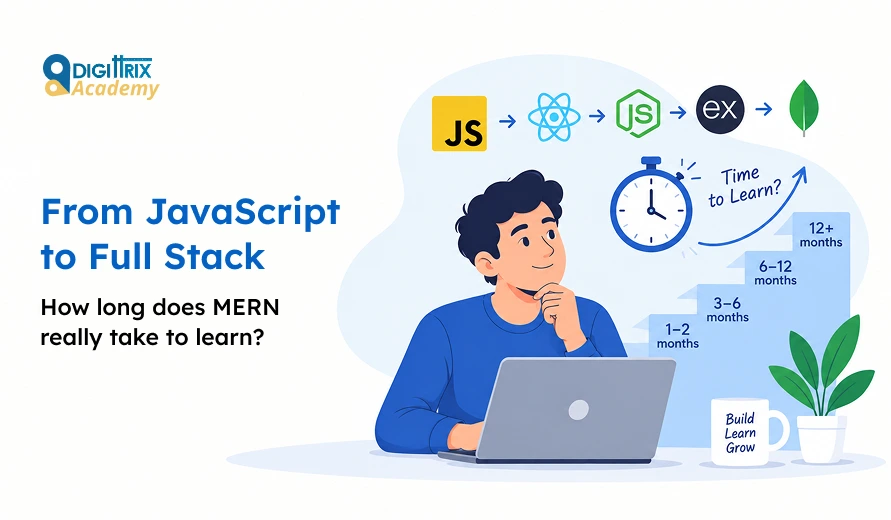
For someone starting with JavaScript, How Long Does MERN Really Take to Learn is an important question because MERN covers several areas of web development. The good news is that you do not need years to become comfortable with the MERN stack. With regular practice, a beginner can build a solid foundation in about 4 to 6 months, while someone who already knows JavaScript may reach project-ready level in around 3 to 4 months.
The exact time depends on your JavaScript skills, weekly study hours, practice routine, and the type of projects you want to build. MERN stands for MongoDB, Express.js, React, and Node.js. Together, these tools can be used to create web applications from the user interface to the server and database.
How Long Does MERN Really Take to Learn?
Curious about career growth in web development? Check Digittrix Academy's MERN Stack Developer Salary insights to understand earning potential at different career stages!
For most learners, 4 to 6 months is a practical estimate when studying for around 10 to 15 hours each week. This MERN Stack learning time can be shorter if you already have strong JavaScript knowledge and longer if you are starting web development from scratch.
A simple timeline looks like this:
- JavaScript and web basics: 4 to 6 weeks
- React: 4 to 6 weeks
- Node.js and Express.js: 3 to 4 weeks
- MongoDB: 2 to 3 weeks
- Full-stack projects: 4 to 6 weeks
- Interview and portfolio preparation: 2 to 4 weeks
These periods can overlap. For example, you can start using MongoDB while building a Node.js application rather than waiting until one topic is finished.
What Should You Know Before Starting MERN?
JavaScript is the most important starting point for MERN. Before moving into React, Node.js, and Express.js, you should be comfortable with variables, functions, arrays, objects, loops, conditions, ES6 syntax, modules, promises, async/await, and basic error handling.
You should also know basic HTML and CSS. You do not need advanced design skills, but you should understand page structure, forms, buttons, layouts, responsive design, and how a browser loads a web page.
Git and GitHub are also worth adding early. They help you save versions of your code, work on different features, and present projects to recruiters.
How Long Does MERN Really Take to Learn? A Month-by-Month Plan
Month 1: JavaScript and Web Foundations
Start with the browser side of web development. Review HTML, CSS, and JavaScript, then spend most of your time writing JavaScript code.
Focus on DOM manipulation, events, array methods, objects, functions, modules, JSON, promises, fetch, and async/await. Build small applications such as a calculator, weather interface, to-do list, or expense tracker.
The goal at this stage is not to memorize every JavaScript feature. You should be able to read code, write small functions, find errors, and understand how data moves through an application.
Month 2: React
Once JavaScript feels comfortable, move to React. Start with components, JSX, props, state, event handling, conditional rendering, lists, forms, and hooks such as useState and useEffect.
Build at least two small React applications. A product listing page, task manager, recipe app, or simple dashboard can give you practice with components and data.
You should also understand routing and API requests before moving deeper into backend work.
Month 3: Node.js and Express.js
Node.js allows JavaScript to run outside the browser. Express.js helps you create server routes and APIs with Node.
Study HTTP methods, REST APIs, request and response objects, middleware, routing, status codes, validation, and error handling. Then create a small backend with user registration, login, and CRUD operations.
At this stage, try to connect your React frontend to your Express API. This is an important step because it shows how separate parts of a web application communicate.
Month 4: MongoDB and Full-Stack Integration
MongoDB stores application data in a document-based format. Study databases, collections, documents, queries, indexes, and basic data modeling. If you use Mongoose, also cover schemas, models, validation, and relationships between data.
Now connect MongoDB with your Node and Express backend. Then connect that backend to your React frontend.
A project such as a job portal, course platform, inventory system, blog platform, or appointment application can bring the four MERN technologies together.
Month 5: Bigger Projects and Code Quality
By the fifth month, spend less time watching tutorials and more time writing your own code. Build one larger application from an empty folder.
Add authentication, protected routes, form validation, search, filtering, pagination, error messages, and user roles where suitable. Keep your project organized with clear folders and reusable components.
You should also practice reading documentation. Real development involves checking official references, testing ideas, and fixing errors without following a video line by line.
Month 6: Portfolio and Interview Preparation
The final stage can focus on polishing two or three strong projects. Add clear README files, screenshots, setup instructions, and a short explanation of the technologies used.
Prepare for questions about JavaScript, React, Node.js, Express.js, MongoDB, APIs, authentication, Git, and basic web concepts.
You should be able to explain your own code. Interview preparation is much easier when you can describe why you selected a particular approach, what problems you faced, and how you fixed them.
How Long Does MERN Really Take to Learn With Daily Practice?
Your weekly schedule matters more than trying to study for long hours on one day.
If you have 1 hour a day, expect the journey to take around 6 to 9 months. With 2 hours a day, 4 to 6 months is realistic for many people. With 3 to 4 focused hours daily, you may reach project-ready level in about 3 to 4 months, provided you already have basic JavaScript knowledge.
A useful daily routine is:
- 30%: Theory and documentation
- 50%: Coding and project work
- 20%: Revision and debugging
Writing code every day helps more than spending most of your time watching tutorials.
How Do You Know You Are Ready for Full-Stack Projects?
You are ready to build full-stack applications when you can create a React interface, send requests to an API, build server routes, store and retrieve data from MongoDB, handle common errors, and use Git for version control.
You do not need to know every library in the MERN ecosystem. You need enough knowledge to build, test, debug, and explain a complete application.
MERN Stack Roadmap: What Should You Study First?
A clear MERN Stack roadmap starts with HTML and CSS, followed by JavaScript. Once your JavaScript foundation is strong, move to React, then Node.js and Express.js, and finally MongoDB.
After covering these technologies, combine them in complete applications. This order helps you understand how the frontend, backend, API, and database work together.
For MERN Stack for beginners, the most useful approach is to avoid trying to study every library at once. Build small applications after each major topic and gradually increase the project size.
Common Mistakes That Make MERN Take Longer
One common mistake is jumping between many courses. Finish a clear topic path and use projects to test what you know.
Another problem is copying project code without understanding it. If you paste a solution, stop and explain each important part in your own words.
Some beginners also spend too much time on tutorials and too little time debugging. Errors are part of programming. Reading error messages, checking documentation, using browser developer tools, and testing one change at a time are important habits.
Trying to study React, Node.js, MongoDB, and several extra libraries at the same time can also create confusion. Follow a sensible order and add tools only when a project needs them.
Is MERN Difficult for Beginners?
MERN can feel difficult at first because it combines frontend development, backend development, APIs, databases, and JavaScript. However, the stack becomes easier to handle when you divide it into smaller sections.
If your JavaScript foundation is strong, React and Node.js become much easier to approach because both use JavaScript. The main challenge is understanding how the frontend, server, and database work together.
For people moving from JavaScript to MERN Stack, the transition can be more comfortable because JavaScript remains the main programming language across several parts of the stack.
Looking to build a successful career in web development? Explore Digittrix Academy's Full Stack Developer Training and Placement insights to connect your learning with real-world hiring opportunities!
How Long Does MERN Really Take to Learn for Full-Stack Development?
The answer depends on your starting point. Someone with strong JavaScript skills may need about 3 to 4 months of consistent practice to build several complete applications. A complete beginner may need 4 to 6 months or more.
Full-stack development with MERN requires more than knowing individual technologies. You should understand how React communicates with an Express server, how Node.js handles requests, and how MongoDB stores application data.
A good final project could be an e-commerce website, job portal, learning platform, booking system, or content management application. These projects give you experience with several parts of full-stack development in one place.
Final Words
MERN does not have a fixed completion date. For a JavaScript developer, 3 to 4 months can be a reasonable target for project-ready skills. For a complete beginner, 4 to 6 months is a more practical range, with extra time for deeper practice.
The best approach is to follow JavaScript with React, then Node.js and Express.js, followed by MongoDB and full-stack projects. Spend more time writing code than watching tutorials, keep your projects small at first, and gradually take on larger applications. With steady practice, How Long Does MERN Really Take to Learn becomes a question you can answer based on your starting point, schedule, and project goals.
About the author
Co-Founder: Harsh Abrol
With Over 14 years of Experience in the IT Field, helping companies optimize their products for more Conversions.
Categories
MERN DevelopmentTable of Contents
- How Long Does MERN Really Take to Learn?
- What Should You Know Before Starting MERN?
- How Long Does MERN Really Take to Learn With Daily Practice?
- How Do You Know You Are Ready for Full-Stack Projects?
- MERN Stack Roadmap: What Should You Study First?
- Common Mistakes That Make MERN Take Longer
- Is MERN Difficult for Beginners?