When people use a MERN Stack application, they usually see the website, buttons, forms, menus, product pages, dashboards, or login screens. These elements belong mainly to the front end. But behind every action, another part of the application is working in the background.
This hidden part is called the backend. The MERN Stack Backend handles tasks such as receiving requests, processing data, verifying user accounts, communicating with databases, enforcing business rules, and sending responses back to the browser. A user may only see a result on the screen, but several server-side operations can occur before that result appears.
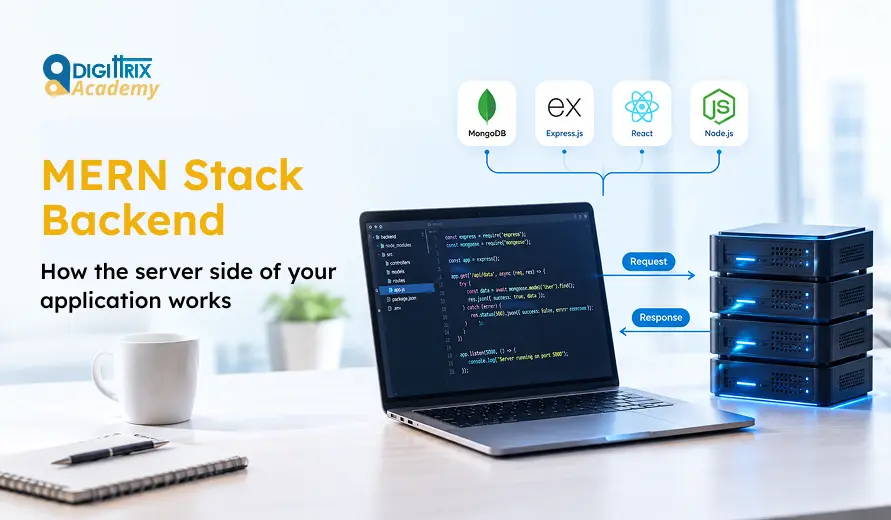
MERN stands for MongoDB, Express.js, React, and Node.js. React is primarily used for the front end, while Node.js, Express.js, and MongoDB form the backend of a MERN application.
This article explains how the MERN Stack backend works, what each technology does, how a request flows through the server, and why backend development is important for modern web applications.
Curious about remote developer salaries? Check Digittrix Academy's MERN Stack developer salary guide to see how location and experience can affect pay!
What Is the MERN Stack Backend?
The MERN Stack Backend is the server-side component of a web application built with Node.js, Express.js, and MongoDB.
Its main job is to receive requests from the front end, process them, work with stored data, and return a suitable response.
For example, suppose a user signs in to an online shopping website. The user enters an email address and password, then clicks the login button.
The process can look like this:
-
React collects the login information.
-
React sends the information to the backend.
-
Node.js runs the server-side JavaScript code.
-
Express.js receives and routes the request.
-
The backend checks the user's information in MongoDB.
-
The server verifies the login details.
-
The backend sends a response.
-
React displays the result.
The backend therefore serves as a bridge between the user interface and the application's data and business rules.
What Technologies Are Used in a MERN Backend?
A MERN backend typically includes three major technologies.
1. Node.js
Node.js allows JavaScript to run outside a web browser. Developers can use it to build server-side applications and web servers.
A Node.js server can receive requests from browsers or other applications and execute code in response.
For example, a server might receive:
GET /products
The Node.js application can handle this request and return product information.
Node.js uses an event-driven architecture, making it well suited for applications that handle many network requests.
2. Express.js
Express.js is a Node.js web framework that provides useful features for building server applications and APIs.
With Express.js, developers can define routes such as:
GET /users
POST /users
GET /products
POST /orders
DELETE /products/:id
Each route can perform a particular server-side task.
Express.js also supports middleware. Middleware functions can check authentication, process requests, handle errors, validate data, and perform other tasks before a request reaches its final route handler.
3. MongoDB
MongoDB is the database commonly used in MERN applications.
It stores information in documents rather than in traditional rows and columns. MongoDB documents use a structure similar to JSON, which works well with JavaScript-based applications.
For example, a user record may look like:
{
"name": "Rahul",
"email": "rahul@example.com",
"role": "student"
}
An application can store users, products, orders, posts, courses, comments, and other types of information in MongoDB.
How Does the MERN Stack Backend Work?
The easiest way to understand the MERN Stack backend is to follow a single request from start to finish.
Imagine a student opens a course website and requests a list of available courses.
Step 1: React Sends a Request
The React front end sends an HTTP request to the backend.
For example:
GET /api/courses
The request tells the server that the application needs course information.
Step 2: Express Receives the Request
Express.js receives the request and determines which route matches it.
A route may look like:
app.get("/api/courses", getCourses);
This tells Express to call the getCourses function whenever a user requests the course endpoint.
Step 3: The Backend Runs Server Logic
The route handler can perform different operations.
It may check whether the user is logged in, apply filters, validate information, or call another service.
For a simple course request, the server may call a database function.
Step 4: MongoDB Provides the Data
The backend sends a query to MongoDB.
MongoDB searches the relevant collection and returns the matching documents.
For example, the database may return:
[
{
"title": "MERN Stack Development",
"duration": "6 Months"
},
{
"title": "Full Stack Web Development",
"duration": "5 Months"
}
]
Step 5: The Server Sends a Response
The backend sends the database result to the React application.
The response may contain JSON data:
{
"success": true,
"courses": [
{
"title": "MERN Stack Development"
}
]
}
Step 6: React Displays the Result
React receives the response and updates the page.
The student now sees the available courses.
This entire process can happen within a very short period.
What Is an API in a MERN Application?
An API, or Application Programming Interface, enables different parts of a software system to communicate with one another.
In a MERN application, the React front end commonly communicates with the Node.js and Express.js backend via APIs.
For example:
|
HTTP Method |
Example Endpoint |
Purpose |
|
GET |
/api/products |
Get products |
|
POST |
/api/products |
Add a product |
|
PUT |
/api/products/:id |
Update a product |
|
DELETE |
/api/products/:id |
Delete a product |
These are common REST API patterns.
Suppose an administrator adds a new product. React can send a POST request to the backend. Express receives the request, the server validates the submitted information, and MongoDB stores the new product.
The backend then sends a response to React indicating whether the operation succeeded.
How Does Authentication Work in MERN?
Authentication verifies whether a person is an approved user of the application.
A common MERN login process works like this:
-
The user enters an email and password.
-
React sends the login request to the backend.
-
Express receives the request.
-
The backend searches MongoDB for the user's account.
-
The backend checks the submitted password against the stored password hash.
-
The server creates an authentication token or session.
-
The response is returned to the front end.
-
The user can access permitted parts of the application.
Passwords should never be stored as plain text. Backend applications typically use password-hashing methods so the original password is not stored directly in the database.
JSON Web Tokens, commonly called JWTs, are a common approach to authentication in MERN projects.
What Is Middleware in Express.js?
Middleware is code that runs during the request-response process.
It can perform tasks before the final route handler responds to the user's request.
For example, an authentication middleware can verify whether a request contains a valid token.
A simplified example is:
app.use("/api/profile", authenticateUser);
The middleware can verify the user's authentication before the request reaches the profile route.
Middleware is also useful for:
-
Logging requests
-
Checking permissions
-
Validating input
-
Handling errors
-
Reading cookies
-
Processing request data
-
Adding security checks
This provides developers with a structured way to handle common server-side operations.
How Does the MERN Stack Backend Connect to MongoDB?
The Node.js backend requires a database connection to read and store application data.
Developers commonly use MongoDB drivers or libraries, such as Mongoose, to communicate with MongoDB.
A typical application flow is:
React
↓
Express API
↓
Node.js Server
↓
Mongoose / MongoDB Driver
↓
MongoDB
When a user creates an account, the backend receives the submitted data and stores it in MongoDB.
When the user later opens their profile, the backend retrieves the required information from MongoDB and sends it back to React.
For students taking a MongoDB course, this request-and-database flow is an important part of understanding how server-side applications store and retrieve information.
What Is the Role of Business Logic?
Business logic consists of the rules that determine how an application should behave.
For example, an e-commerce application may have rules such as:
-
A product cannot be purchased when its stock is zero.
-
A customer can place an order only after providing required information.
-
A discount code can be used only during its valid period.
-
An administrator can remove products.
-
A regular customer cannot access administrative functions.
These rules should be handled on the server because front-end code alone should not be trusted to make important application decisions.
The backend validates the request and applies the application's rules before modifying or returning data.
How Is a MERN Backend Structured?
A well-organized MERN project often separates its server-side code into distinct folders.
A simple structure may look like:
backend/
│
├── controllers/
├── models/
├── routes/
├── middleware/
├── services/
├── config/
├── utils/
└── server.js
Routes
Routes define API endpoints.
Controllers
Controllers handle the main operations for incoming requests.
Models
Models describe how application data is represented and stored.
Middleware
Middleware manages shared request-processing tasks.
Services
Services can include reusable application operations, such as sending emails or processing payments.
Config
Configuration files can manage database connections and other server-side settings.
This type of structure makes larger projects easier to maintain.
Students working on MERN projects can use this structure to separate different parts of an application and keep the code easier to manage.
How Does Error Handling Work in a MERN Backend?
Errors can occur for many reasons.
A database may be unavailable. A user may submit incomplete information. A requested product may not exist. An API request may contain invalid data.
The backend should handle these cases and return meaningful HTTP responses.
For example:
200 – Request successful
201 – Resource created
400 – Invalid request
401 – Authentication required
403 – Access denied
404 – Resource not found
500 – Server error
Instead of letting the application fail without a useful response, the backend can return a structured error message.
For example:
{
"success": false,
"message": "Product not found"
}
React can then display an appropriate message to the user.
Why Is Backend Development Important in MERN?
A front end alone cannot normally handle the full requirements of a real-world application.
The backend is responsible for areas such as:
-
Database communication
-
Authentication
-
Authorization
-
API development
-
Data validation
-
Business rules
-
Server-side processing
-
Error handling
-
Security checks
-
Integration with external services
For example, a course platform may use React for course pages and dashboards, while the backend manages users, course records, payments, progress data, and access permissions.
The front end displays information, while the backend handles much of the processing behind the scenes.
This makes backend knowledge useful for anyone preparing for a Full Stack Developer role, in which both the user interface and server-side systems are part of the work.
MERN Stack Backend vs MERN Frontend
The frontend and backend work together, but they have distinct responsibilities.
|
Frontend |
Backend |
|
React |
Node.js |
|
User interface |
Server-side operations |
|
Forms and pages |
APIs |
|
Browser interactions |
Database communication |
|
Displays data |
Processes data |
|
Client-side validation |
Server-side validation |
|
User-facing components |
Authentication and permissions |
A complete MERN application needs these components to communicate properly.
This combination is also central to Full Stack Development, where developers work on the front end, back end, database, APIs, and application logic.
What Skills Are Needed for MERN Backend Development?
Someone preparing for MERN backend development should build a strong foundation in the following:
-
JavaScript
-
Node.js
-
Express.js
-
MongoDB
-
REST APIs
-
HTTP methods
-
Authentication
-
Authorization
-
Database operations
-
Error handling
-
Git and version control
-
Basic web security
-
API testing
It is also useful to understand how React communicates with backend APIs because MERN development involves both the frontend and backend working together.
A Node.js Course can provide a focused foundation in server-side JavaScript, while a Web Development Course can cover the broader process of building websites and web applications.
For students preparing for a MERN Stack Internship or a MERN Developer Internship, practical work with APIs, database operations, authentication, and small application builds can provide valuable experience.
What Should You Build to Practise MERN Backend Development?
Practical projects are an effective way to apply backend concepts.
Some suitable MERN Projects include:
1. Student Management System
Create APIs for adding, updating, viewing, and deleting student records.
2. E-Commerce Application
Build product APIs, user authentication, shopping cart, and order management.
3. Blog Application
Create APIs for posts, comments, user accounts, and content management.
4. Course Management Platform
Store course information in MongoDB and build APIs for students, instructors, courses, and enrollments.
5. Task Management Application
Allow users to create, update, delete, and track tasks via a React interface connected to a Node.js and Express.js backend.
Projects like these can also provide students with material to discuss during interviews and internship applications.
How Does MERN Backend Knowledge Help With Career Preparation?
A strong understanding of server-side development can help students understand how complete web applications work.
For example, someone taking a MERN Stack Course may start with JavaScript before moving on to React, Node.js, Express.js, and MongoDB. Backend topics then become part of the broader application-building process.
Similarly, students taking a React.js course can understand how React sends requests to APIs, while server-side knowledge explains what happens after those requests leave the browser.
The goal is not simply to write individual pieces of code. It is to understand how the different parts of a web application communicate and work together.
Choosing the right development environment matters. Check Digittrix Academy's guide to the best IDE for MERN Stack to find the right setup for your project!
Final Words
The MERN Stack Backend is the part of the application responsible for server-side processing, APIs, database communication, authentication, validation, and business logic.
The basic flow is easy to remember:
React sends a request → Express receives it → Node.js runs the server code → MongoDB stores or returns data → the backend sends a response → React displays the result.
Once this request-and-response cycle is clear, the structure of a MERN application becomes much easier to understand. Node.js provides the runtime environment, Express.js manages server requests and APIs, and MongoDB stores application data. Together, these technologies form the core server-side foundation of a MERN application.
About the author
Co-Founder: Harsh Abrol
With Over 14 years of Experience in the IT Field, helping companies optimize their products for more Conversions.
Categories
MERN DevelopmentTable of Contents
- What Is the MERN Stack Backend?
- What Is an API in a MERN Application?
- How Does Authentication Work in MERN?
- What Is Middleware in Express.js?
- How Does the MERN Stack Backend Connect to MongoDB?
- What Is the Role of Business Logic?
- How Does Error Handling Work in a MERN Backend?
- Why Is Backend Development Important in MERN?
- MERN Stack Backend vs MERN Frontend
- What Skills Are Needed for MERN Backend Development?