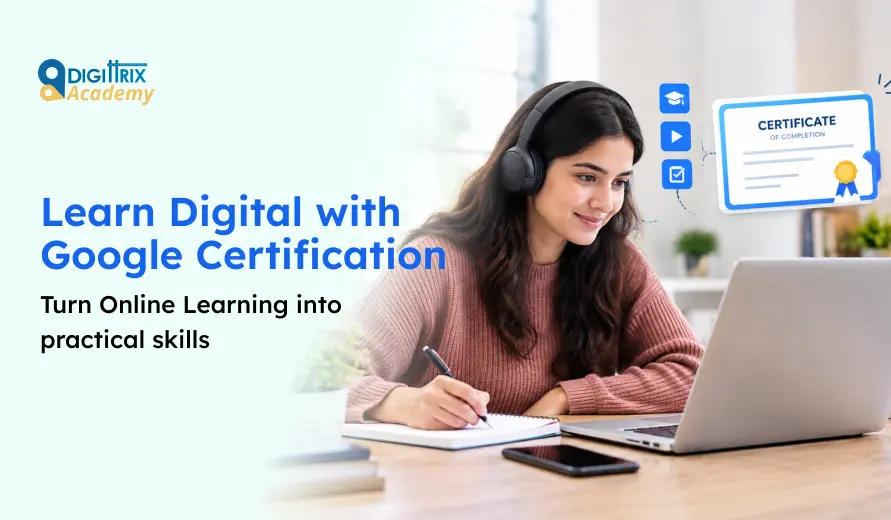
Digital skills have quietly become table stakes — for students, job seekers, business owners, freelancers, working professionals, and pretty much everyone trying to stay relevant. Most people already watch the videos, read the blogs, and click through the free courses. What trips them up is the next step: actually applying any of it to real work. That's the gap the Learn Digital with Google Certification is built to close — structured online training, hands-on activities, and a certificate you can put on a professional profile.
Google offers several courses and certification tracks covering digital marketing, data analytics, project management, UX design, IT support, cybersecurity, and a handful of other career-focused areas. None of them assume a technical background — they're designed for people trying to become job-ready, not for those who already are.
For someone just starting a digital career, the Learn Digital with Google Certification offers a real bridge between basic theory and the kind of tasks you'd actually be handed on day one of a job.
Want to build campaigns around measurable results? Check Digittrix Academy's Performance Marketing insights to strengthen your campaign skills!
What Exactly Is a Google Certification?
It's a professional credential you earn by completing a specific Google training program and passing its assessments. Most Google Career Certificate programs are delivered through online education platforms and focus squarely on the skills people use in real-world workplace situations — not abstract theory.
A Google digital marketing certification, for instance, typically touches:
-
Search engine optimization
-
Social media marketing
-
Email marketing
-
Online advertising
-
E-commerce
-
Marketing analytics
-
Customer interaction
-
Content planning
The point is structured training around one specific career path — not a scattershot overview of everything at once.
Worth being honest about, though: a certificate on its own doesn't guarantee a job. Its real value shows up when it's backed by projects, hands-on work, a resume that reflects that work, and the ability to talk through what you did in an interview.
Why People Choose Google Certification for Digital Skills
Online education gives you access to more information than you could ever need — which is sort of the problem. Too many resources, not enough clarity on where to start.
Google certification programs solve that by giving you a clear path. Instead of bouncing between unrelated videos and half-finished articles, you follow a sequence of lessons centered on a specific goal.
A few reasons people gravitate toward these programs:
1. Structured course content. Everything's arranged in a logical sequence — beginners start with fundamentals before moving on to more advanced material. A digital marketing program, for example, usually opens with the basics and then works through search, social, email, analytics, advertising, and e-commerce.
2. Career-focused skills. Most Google certification courses are built around real-world job roles, keeping the content grounded rather than theoretical. Depending on the certificate, that might mean preparing for roles like:
-
Digital marketing coordinator
-
SEO specialist
-
Social media coordinator
-
E-commerce associate
-
Data analyst
-
Project coordinator
-
IT support specialist
-
UX designer
3. Practical activities. This is where career-oriented online education really earns its keep. Reading about keyword research and actually building a keyword list are two very different experiences. The same goes for understanding social strategy in theory versus sitting down to build a real content calendar. The hands-on assignments are what turn a concept into something you can actually do.
4. A recognized brand. Google carries real weight across tech and business. A Google certificate on a resume signals that someone completed structured training in a specific subject — employers will still weigh experience, communication, projects, and technical ability, but the certificate adds another piece of evidence that the preparation was real.
Turning Online Training Into Actual Skill
Watching a lesson is step one. The real value only shows up once you apply it to something real.
Take someone studying digital marketing. Instead of just reading about SEO, they could spin up a small website and actually practice:
-
Finding relevant search terms
-
Grouping keywords by intent
-
Writing page titles and descriptions
-
Creating genuinely useful content
-
Improving page structure
-
Checking performance
-
Reviewing search data
-
Putting together a basic SEO report
The same logic applies to social media. Build a sample brand, draft posts, write captions, build out a content calendar, study audience behavior, and put together a monthly report. This is exactly what turns the Learn Digital with Google Certification from a passive video-watching exercise into real skill-building — the lessons only matter once they are applied to real or simulated tasks.
What Skills Can You Actually Build?
It depends on which certificate you choose, but for digital marketing specifically, a few areas stand out.
Search Engine Optimization. Helping sites show up for the searches that matter. Expect work on keyword research, on-page SEO, content planning, basic technical SEO, internal linking, and measuring what actually worked.
Social Media Marketing. Covers platforms like Instagram, Facebook, LinkedIn, and others, with practical work on content calendars, captions, creative planning, audience research, and campaign reporting.
Paid Advertising. Requires understanding of audiences, campaign goals, ad formats, budgets, targeting, and how to interpret the resulting performance data. A typical exercise might have you build a sample ad campaign for a fictional business and explain why you chose the audience and messaging.
Email Marketing. Still very much alive as a channel. Training usually covers campaigns, audience segmentation, subject lines, content planning, calls to action, and how to interpret results.
Analytics. Marketing decisions live and die by data. Students practice interpreting traffic, engagement, conversions, and campaign outcomes — and honestly, being able to explain what the numbers mean matters more than just knowing where to find them.
What to Do With the Certificate Once You Have It
Finishing the certificate isn't the finish line — treat it as a starting point for building a real portfolio.
A digital marketing student, for instance, might build out:
-
SEO audit of a sample website
-
Keyword research sheet
-
Three-month content calendar
-
Social media campaign plan
-
Sample Google Ads campaign
-
Email campaign
-
Website performance report
-
Competitor analysis
-
Monthly marketing report
These are the things employers can actually look at. A resume can claim you completed digital marketing training — a portfolio proves what you can do with it.
Does This Actually Help Land a Job?
A certificate can support a job search, but it's just one piece of a much bigger picture. Employers tend to weigh factors like:
-
Educational background
-
Relevant certificates
-
Practical projects
-
Internship experience
-
Portfolio quality
-
Communication skills
-
Problem-solving ability
-
Familiarity with industry tools
-
Prior work experience
For a recent graduate, projects and internships carry real weight — they're proof of applying skills, not just learning about them. In an interview, saying "I completed a digital marketing course" lands very differently than walking someone through how you ran keyword research, built a content plan, analyzed campaign data, or drafted a sample strategy. The second version is what actually sticks.
Google Certification vs. Traditional Classroom Training
Both paths have real advantages, and the right call depends on the person.
|
Google Certification |
Classroom Training |
|
Online access |
Face-to-face sessions |
|
Flexible study schedule |
Fixed class timings |
|
Career-focused course structure |
Depends on the institute |
|
Practical assignments often included |
Practical work depends on the program |
|
Certificate after meeting requirements |
Certificate from the training provider |
|
Suitable for self-paced study |
Direct classroom interaction |
It really comes down to schedule, preferred learning style, budget, and where you're trying to end up. Many people do best by combining online certification with classroom work, internships, and personal projects rather than picking just one lane.
How Long Does a Google Certificate Actually Take?
It depends heavily on the specific certificate, your schedule, prior knowledge, and pace. Someone studying a few hours a week will naturally take longer than someone working through it daily.
Rather than racing through modules, it's worth actually sitting with the practical work — finishing a module fast means little if you can't do the related task on your own afterward. A rough pacing guide:
-
Weeks 1–2: Get the basic concepts down
-
Weeks 3–4: Practice individual skills
-
Weeks 5–6: Work on small projects
-
Weeks 7–8: Build out portfolio pieces
-
After completion: Start applying for internships and entry-level roles
This keeps education, practice, and actual career prep moving together rather than happening in isolation.
Adding Google Certification to Your Resume
List it under a section like "Certifications" or "Professional Training," and include:
-
Certificate name
-
Issuing organization
-
Completion date
-
Relevant skills
-
Certificate link, if available
For example:
Google Digital Marketing & E-commerce Professional Certificate
Google
Skills: SEO, social media marketing, email marketing, e-commerce, analytics, digital advertising
It also helps to directly tie these listed skills to your portfolio. If SEO is on the resume, there should be an SEO project in the portfolio to back it up.
Is This Good for Beginners?
Digital marketing certification for beginners tends to work well because most career-focused programs start from the ground up — prior professional experience is usually not required.
That said, be ready to put in practice time outside the lessons themselves. Starting from zero often means doing extra reps with tools like:
-
Google Analytics
-
Google Search Console
-
Google Ads
-
Canva
-
WordPress
-
Excel or Google Sheets
-
Social media management platforms
-
Keyword research tools
The goal was never to rack up as many certificates as possible. It's about building abilities you can actually demonstrate, not just claim.
What Comes After the Certificate?
The next phase is all about practice and actually applying it. Worth doing:
-
Build a small portfolio
-
Create real marketing projects
-
Apply for internships
-
Take on freelance work
-
Volunteer for a small business or student organization
-
Update your resume and LinkedIn
-
Practice common interview questions
-
Keep working hands-on with relevant tools
-
Track how your projects actually perform
-
Keep adding new work to the portfolio
This is what gives the certificate an actual purpose beyond the line on a resume.
Want to solve the technical issues affecting your rankings? Check Digittrix Academy's Advanced Technical SEO insights to strengthen your SEO skills!
Final Words
Learn Digital with Google Certification offers a genuinely structured route for anyone trying to build digital skills through online learning — but its real value shows up in what students do with the material after each lesson, not during it.
Someone studying SEO can run real website audits. A social media student can build an actual content calendar. Someone in advertising can put together a sample campaign. An analytics student can produce a real performance report. These are the activities that turn course knowledge into proof of actual ability.
For beginners especially, the smartest approach pairs Google certification with regular practice, portfolio work, internships, and real assignments. The certificate shows structured training happened; the practical work shows what that training turned into. Put together consistently, that combination is what makes digital skills genuinely demonstrable — in interviews, internships, freelance work, and that first entry-level role.
About the author
Co-Founder: Vandana Abrol
An enthusiastic developer and skilled business management expert with over a decade of experience in the field
Categories
Digital MarketingTable of Contents
- What Exactly Is a Google Certification?
- Why People Choose Google Certification for Digital Skills
- Turning Online Training Into Actual Skill
- What Skills Can You Actually Build?
- What to Do With the Certificate Once You Have It
- Does This Actually Help Land a Job?
- Google Certification vs. Traditional Classroom Training
- How Long Does a Google Certificate Actually Take?
- Adding Google Certification to Your Resume
- Is This Good for Beginners?