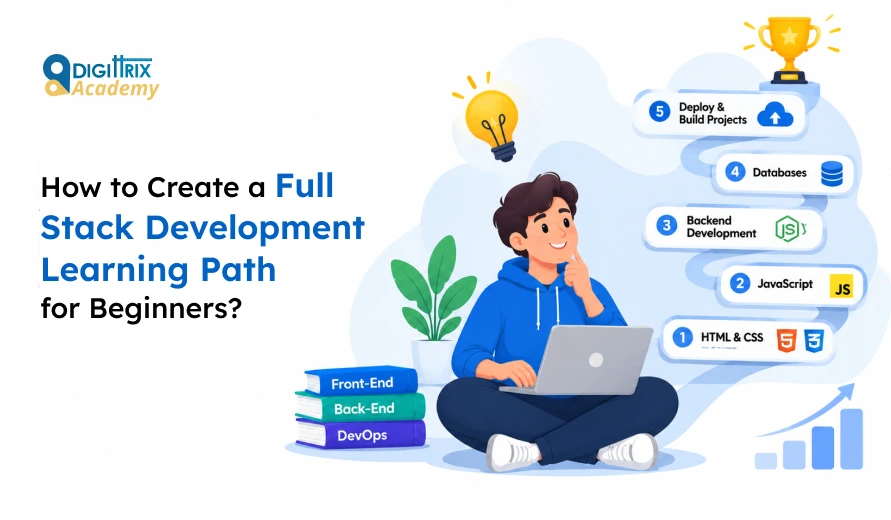
Short answer: To build a full stack development learning path, study in this order: web basics (HTML, CSS, and JavaScript), Git, a front-end library such as React, a back-end with Node.js and Express, a database such as MongoDB, then login, security, and deployment. Build one small project after each stage and finish with two or three complete projects. At 10 to 15 hours a week, most beginners need roughly nine to twelve months to reach an entry-level standard. The time changes with your background and how regularly you practise.
What Is Full Stack Development?
A full-stack developer builds both sides of a web application.
- Front end: Everything a user sees and clicks, such as pages, forms, buttons and menus.
- Back end: The server, business rules, login system, and database that sit behind the screen.
- Tools around the code: Version control, testing, hosting, and domain setup.
You do not need to know everything at an expert level. A good full stack developer roadmap for beginners starts small and adds one skill at a time. You need to build a working product from a blank folder to a live website. This full stack development learning path takes you there in a fixed order, so each step rests on the one before it.
Want to build applications with real-time features? Check Digittrix Academy's guide to building MERN Stack real-time applications to understand how technologies like MongoDB, Express.js, React, and Node.js work together to support live updates and interactive user experiences!
Choose Your Stack for Your Full Stack Development Learning Path
Pick one stack and stick with it for the entire path. Switching halfway is the most common reason beginners stall.
|
Stack |
Languages and tools |
Suits you if |
|
MERN |
MongoDB, Express.js, React, Node.js |
You want one language (JavaScript) everywhere |
|
MEAN |
MongoDB, Express.js, Angular, Node.js |
You prefer a structured framework with strict rules |
|
Python stack |
Python, Django or Flask, React |
You like Python or plan to move into data work |
|
Java stack |
Java, Spring Boot, React |
You aim for large company or bank projects |
For most beginners, MERN is the easiest way to start because one language covers the browser, the server, and database queries. The steps below follow a MERN stack learning path, but the order works for any stack.
Full Stack Development Learning Path at a Glance
|
Phase |
What you study |
Rough time |
What you can do afterwards |
|
1. Web basics |
How the internet, HTTP, and browsers work |
1 week |
Explain a request and a response |
|
2. HTML and CSS |
Page structure, layout, responsive design |
3 to 4 weeks |
Build a responsive static site |
|
3. JavaScript |
Language basics, DOM, async code |
6 to 8 weeks |
Build interactive pages |
|
4. Git and GitHub |
Commits, branches, pull requests |
1 week |
Store and share your code |
|
5. React |
Components, state, hooks, routing |
5 to 6 weeks |
Build a single-page app |
|
6. Node.js and Express |
Servers, routes, middleware, REST APIs |
4 to 5 weeks |
Build a working API |
|
7. Database |
MongoDB, Mongoose, data design |
3 to 4 weeks |
Save and read real data |
|
8. Login and security |
Passwords, tokens, validation |
2 to 3 weeks |
Protect routes and users |
|
9. Deployment |
Hosting, environment variables, domains |
1 to 2 weeks |
Put a project online |
|
10. Capstone projects |
Two or three complete apps |
6 to 8 weeks |
Show proof of skill |
Use this full stack web development roadmap as a rough guide, since timelines vary from person to person. Move on only when you can build the phase’s project without copying a tutorial line by line.
Step-by-Step Full Stack Development Learning Path
Step 1: Start the Full Stack Web Development Roadmap With Web Basics
Before you write code, understand what happens when you open a website. Study what a browser, server, domain name, IP address, and HTTP request are. Open your browser’s developer tools and look at the Network tab to see requests flow. Also get comfortable with a terminal, since you will use it daily.
Step 2: Build Pages With HTML and CSS
Study semantic HTML tags, forms, links, and images. In CSS, focus on the box model, Flexbox, Grid, media queries, and basic accessibility. Skip heavy animation for now.
Project: A personal portfolio page that works on phone, tablet, and desktop.
Step 3: Study JavaScript, the Core of Full Stack Developer Skills
This step determines how fast the rest goes, so give it the most time. Cover:
- Variables, data types, functions and scope
- Arrays, objects and their built-in methods
- Loops, conditions and error handling
- DOM selection and events
- Promises, async/await and the fetch API
- Modern syntax such as destructuring, modules and arrow functions
Projects: A to-do list, a quiz app and a weather page that calls a public API.
Step 4: Use Git and GitHub From the Start
Create a GitHub account and save every project there. Practise git init, add, commit, branch, merge, and pull requests. A clean commit history shows employers how you work.
Step 5: Build Front Ends With React in a MERN Stack Learning Path
Study components, props, state, useState, useEffect, forms, lists, conditional display, and React Router. Then add one state tool, such as the built-in useReducer, only when a project needs it.
Projects: An expense tracker and a movie search app with filters.
Step 6: Build Servers With Node.js and Express
Study how Node.js executes JavaScript outside the browser. Then build REST APIs with Express, using routes, controllers, middleware, and error handling. Test each route with Postman or Thunder Client.
Step 7: Store Data in a Database
Start with MongoDB and Mongoose: schemas, models, and CRUD (create, read, update, and delete), relationships, and indexes. Spend one or two weeks on basic SQL as well, since many companies use MySQL or PostgreSQL and interviews often ask about joins and keys.
Step 8: Add Login and Security
Study password hashing with bcrypt, JSON Web Tokens, protected routes, input validation, CSRF, RS, and environment variables. Never store passwords in plain text or commit secret keys to GitHub.
Step 9: Deploy Your Work
Host the front end on a platform such as Vercel or Netlify, the back end on a platform such as Render or Railway, and the database on MongoDB Atlas. A live link on your resume carries more weight than code that runs only on your laptop.
Step 10: Build Capstone Full Stack Development Projects for Beginners
Build two or three complete apps that combine every step. Good full stack development projects for beginners include:
- E-commerce store with product pages, cart, login, and orders
- Job board with employer and candidate roles
- Chat or booking app with real-time updates
Write a clear README for each: what it does, which tools it uses, how to run i,t and a screenshot.
Sample Weekly Study Routine
A routine you can sustain is better than a perfect plan you abandon in week three. Build your full stack development learning path around the hours you actually have.
|
Day |
Task |
Time |
|
Monday to Thursday |
Study one topic, then code an example |
1.5 to 2 hours |
|
Friday |
Review notes and fix earlier mistakes |
1 hour |
|
Saturday |
Build a project feature |
3 to 4 hours |
|
Sunday |
Rest or read documentation |
Optional |
Spend about one-third of your time on reading or video, and two-thirds on writing code.
How to Study Without Getting Stuck
These habits keep a full stack development learning path moving when motivation drops.
- Build after every topic. Close the tutorial and make a small version yourself.
- Read official documentation. MDN Web Docs, react.dev, the Node.js docs, and MongoDB docs are free and accurate.
- Use a few good courses. The Odin Project, freeCodeCamp, and CS50 from Harvard are free and well-known. Pick one main full stack development course for beginners and finish it.
- Debug on your own first. Read the error, search it, then ask for help with a clear question and your code.
- Commit daily. A green GitHub activity chart builds a habit and shows consistency.
- Join a community. A study group or a local developer meetup keeps you moving when motivation drops.
Common Mistakes in a Full Stack Developer Roadmap for Beginners
- Chasing every new tool. Stay with one stack until you finish a full project.
- Watching tutorials without building. Watching feels like progress, but only coding builds skill.
- Skipping JavaScript basics. Weak JavaScript makes React and Node.js feel confusing.
- Ignoring Git. Most teams expect you to know it on day one.
- Building only clones. Add one feature of your own to every project so it is not a copy.
- Leaving deployment for last. Deploy your first small project early, so you meet hosting problems with low stakes.
Job-Readiness Checklist for Beginners
Entry-level roles in India, whether through campus placements or online applications, commonly test full stack developer skills such as JavaScript, one front-end library, basic database knowledge, and a walkthrough of your projects. Before you finish your full stack development learning path and apply, check that you have:
- Three or more projects online, with live links and a README
- A GitHub profile with regular commits
- A one-page resume that lists your stack and project links
- Basic data structures and algorithms, such as arrays, strings, hash maps, and sorting
- Knowledge of DBMS basics, REST, authentication, and how you deployed your apps
- Two or three mock interviews with a friend or mentor
Planning to learn full-stack web development in 90 days? Check Digittrix Academy's practical MERN Stack study plan to understand the learning timeline, essential technologies, and projects you can work on while building your development skills!
Follow This Roadmap With Guidance From Digittrix Academy
A written plan is a good start, but progress accelerates when someone reviews your code and answers your questions. Digittrix Academy offers MERN stack training covering MongoDB, Express.js, React, and Node.js. You build full projects step by step, from your first React page to a deployed app with login and a database.
To ask about courses and admissions, email tanvi@digittrix.com, or visit Digittrix Academy.
About the author
Co-Founder: Harsh Abrol
With over 14 years of Experience in the IT Field, helping companies optimise their products for more Conversions.
Categories
MERN DevelopmentTable of Contents
- What Is Full Stack Development?
- Choose Your Stack for Your Full Stack Development Learning Path
- Full Stack Development Learning Path at a Glance
-
- Step 1: Start the Full Stack Web Development Roadmap With Web Basics
- Step 2: Build Pages With HTML and CSS
- Step 3: Study JavaScript, the Core of Full Stack Developer Skills
- Step 4: Use Git and GitHub From the Start
- Step 5: Build Front Ends With React in a MERN Stack Learning Path
- Step 6: Build Servers With Node.js and Express
- Step 7: Store Data in a Database
- Step 8: Add Login and Security
- Step 9: Deploy Your Work
- Step 10: Build Capstone Full Stack Development Projects for Beginners
- Sample Weekly Study Routine
- How to Study Without Getting Stuck
- Common Mistakes in a Full Stack Developer Roadmap for Beginners
- Job-Readiness Checklist for Beginners
- Follow This Roadmap With Guidance From Digittrix Academy